
“In the ordinary, unnoticed moments of life, God’s hand is always at work.” Sandi
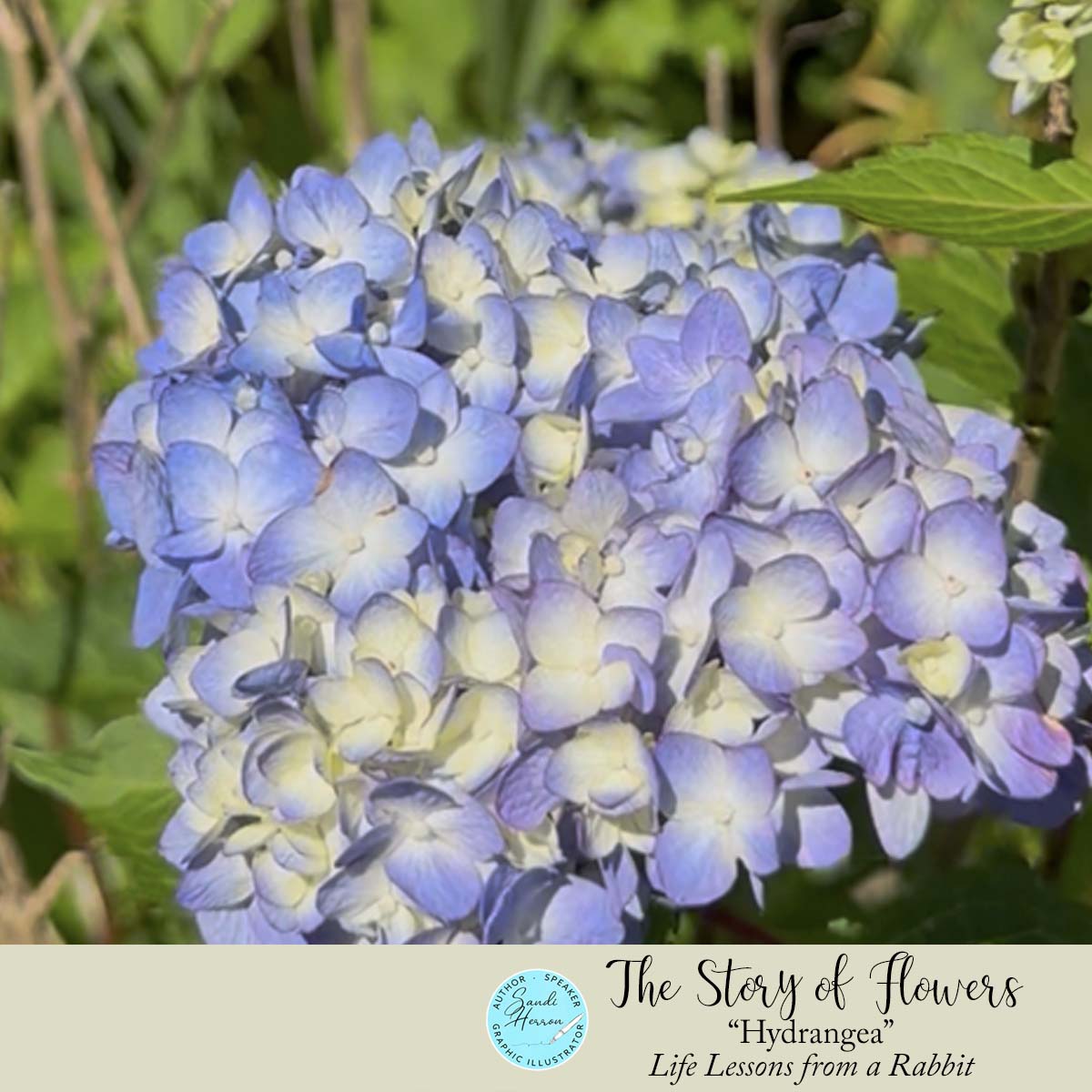
Today, I worked in my gardens, clearing out weeds, fallen limbs, and blooms that have finished their season. Our recent cold temperatures changed our gardens overnight, showing us a new season has arrived. While shaping my hydrangeas so they go through the winter looking somewhat interesting, I remembered a story I wrote a few months ago. It’s not exactly a story you would expect for November, but the lesson is valuable anytime of the year. And just so you know, I do talk to my plants. And rabbits that show up every so often!
Life Lessons from a Talking Rabbit
It was the kind of Southern morning where the air smelled like jasmine and the world felt like it had already had a second cup of coffee. Mildred Grace Monroe—Milly to everyone but telemarketers—was in her garden, humming “How Great Thou Art.” As she trimmed back the overenthusiastic lemon balm, her flourishing hydrangeas caught her eye.
“Look at y’all,” she said to the bushes, hands on hips, “showin’ off again.”
Hydrangeas were her favorite. Big-hearted blooms, soft as a baby’s breath, and capable of changing color based on the soil beneath them.
As Milly stooped to pull a weed near the hydrangeas, something moved behind the bushes. Not a rustle. More like a shuffle.
She carefully leaned in closer. “Now if that’s you, Mr. Raccoon, I’m not afraid to call animal control.”
Out popped a rabbit. Brown, round, and wearing an expression of mild disapproval.
“Don’t lump me in with those masked hooligans,” the rabbit said in a rich Southern drawl. “I’ve got manners.”
Milly froze, pruning shears in hand. “Oh no,” she whispered. “I’ve either lost my mind or didn’t drink enough coffee this morning.”
The rabbit sat back on its haunches and offered a slight bow. “Name’s Beauregard T. Whiskers. Most folks call me Beau.”
Milly squinted. “Beau. Are you real?”
“As real as a biscuit on Sunday,” he said. “And twice as fluffy.”
Still crouched near her hydrangeas, Milly dropped her shears and sat on the ground eye to eye with the rabbit, not quite sure if this was a dream or divine appointment.
“You always talk?” she asked in a shaking voice.
“Only when necessary. And only to gardeners who hum old hymns while pulling weeds.”
Milly laughed, startled and delighted. “Well, that narrows it down.”
Beau hopped closer to the hydrangeas and touched a bloom with his round nose. “These are fine specimens. Did you know hydrangeas are among the longest-living flowering shrubs? Fifty years or more if cared for.”
“I did know that,” Milly said, pleased. “Planted these when my youngest left for college. Thought I needed something to tend to besides myself.”
“Smart woman,” Beau nodded. “Hydrangeas take their time. Grow slow and teach patience. Need enough water to thrive but not too much. Soggy ground will ruffle their composure quicker than a humid July afternoon.”
“I know some people like that—they need the right conditions to thrive. And if their feet get soaked? Oh, do they fuss.”
Beau chuckled. “Takes a sense of humor to work a garden. Also takes faith.”
Milly brushed dirt off her gloves and took a deep breath. “Funny you say that. These flowers have seen me through a lot of quiet seasons. Times when I felt like everyone else was blooming and I was just sitting in the dirt.”
“Hydrangeas do that too,” said Beau. “They don’t always bloom big. Some years, they rest. Rebuild their strength underground. Doesn’t mean they’re done. Just means they’re preparing.”
Milly nodded, feeling an unexpected lump rise in her throat. “Guess I’ve had a few of those years myself.”
“No shame in it,” Beau replied. “Rest is purposeful work. Don’t let anybody tell you differently.”
She smiled—truly smiled, the kind that starts somewhere near the ribs and works its way upward. “Thank you, Beau. For… well, for whatever this is.”
Beau shrugged, as though magical conversations with humans were simply part of his weekly errands. “Just keep tending things,” he said. “Your garden. Your heart.”
With that, Beau turned toward the hydrangeas, twitched his tail once like a polite farewell, and hopped toward the far side of the garden. Milly watched him slip between the bushes, his brown fur blending into the dappled shade until he vanished completely. No rustle, no shuffle this time. Just gone.
For a long moment she sat in the warm morning light, listening to the buzz of bees. She picked up her pruning shears, dusted off her knees, and whispered to the hydrangeas, “Well now… wasn’t that something? Oh, my imagination!”
The blooms nodded in the faint breeze as if to agree.
Milly took one last look at the blooms, released a deep, cleansing breath, and headed down the familiar path to her porch. “Lord, I’ll trust You,” she whispered, “even when the growing is hidden.” A calmness washed over her, laying itself across her shoulders like morning light breaking through the trees.
She came to the garden with a heavy heart, but left with a heart filled with gratitude for times of rest. Somewhere through the trees a voice whispered, “Tend your gardens. I’ll tend your heart.”
Reflection Questions
Are you in a blooming season, or a resting one?
How might God be tending to your roots in quiet, unseen ways?
What “weeds” in your thoughts or habits might be crowding out the growth God wants for you?
Where Do We Go From Here
Milly’s story isn’t really about a talking rabbit. It’s about how God meets us in the middle of our ordinary days and whispers truth into the places where we stopped hoping. It reminds us that the parts of our lives we consider unimportant, like gardens, routines, or the places we tend when no one is watching, are often where God plants seeds of hope.
Perhaps, like Milly, you’ve walked through seasons when life felt stagnant—when everything inside you seemed to wait for permission to bloom again. Maybe that’s where you find yourself now, and God is using Milly’s story to gently nudge your heart, reminding you that He hasn’t forgotten you, that rest isn’t failure, and that growth doesn’t always begin above the surface.
If something in you stirred, even a little, hold onto it. Better days are coming.
Notice the Ordinary Places. Think about the ordinary spaces of your life —your morning routine, your kitchen, your backyard, your drive to work, hiking on a trail through the woods, even grocery shopping. Ask God to help you notice His presence there. Sometimes He whispers in the spaces we rush past.
Tend What Needs Tending. Just as Milly tended her hydrangeas, consider one area of your life—your faith, relationships, rest, habits—that needs gentle pruning or fresh care. Small, intentional steps can create surprising growth.
Honor the Resting Seasons. If you’re in a season of quietness, a standstill, don’t dismiss it. Ask God what He’s rebuilding beneath the surface. Give yourself permission to linger, breathe, and heal.
Say Yes to the Unusual Ways God Speaks. Maybe God has been nudging you through a conversation, a memory, or something that caught your attention in a way you can’t fully explain. Lean into it. Ask, “Lord, what are You trying to show me?”
Carry the Message Forward. Milly left her garden changed, not because of the an imaginary rabbit, but because she recognized the heart behind the message. What truth do you need to carry with you today, back into your world?
Take one step—just one—before the day ends. Pray. Write a note. Pull a weed, literal or metaphorical. And trust that God, the Master Gardener, is tending the garden of your life.
Let’s Pray
Lord, help us to bloom in Your timing. When we feel dry, remind us to return to Your living water. Teach us that deep roots are part of Your plan and we don’t always see what You doing beneath the surface in our lives. Show us how to live like a hydrangea—faithful, trusting your timing, and sustained by Your care. In Jesus’ name, amen.
“… So neither the one who plants nor the one who waters is anything. Only God, who makes things grow.”
1 Corinthians 3:6-7 (NLT)
Find a place to shut yourself away from the noise of the world and worship with Kari Jobe, “The Garden“
What a cute story! It’s hard when you don’t see the growth happening underground. You see others bloom and wonder if you ever will. I’ve learned to take it to the Lord. When I did, he told me to be happy for the ones who are blooming, and when i set my mind to obey, I found I truly was happy for my friends.
What a wonderful story. It’s a beautiful reminder that God meets us in the quiet, overlooked parts of our lives and whispers hope into the places we need it most. Thank you for showing how He uses even the still seasons to prepare us for new growth. Your words encouraged me today.
I love this story and the fun dialogue between Milly and Beau. I felt as if I was right there in the garden, and Beau is so believable. The patience, rest, and finding purpose woven into this story are just the things I needed to read. I’m encouraged. Will Beau be visiting with us again? I hope so. Thank you!
What a beautiful story! It speaks to me in so many different ways. Thanks for the lovely reminder of how God is always at work, even when we do not know it. I hope your garden grants many more such stories in the days to come.
Gail, thank you! It’s amazing how one little bunny hopping through the garden can teach us about God’s hand in the details of our lives. Glad you enjoyed it!
I loved this story. It made me smile and ponder the gentleness of my heavenly Father.
Thank you Marilyn. While working in my gardens, a lot of stories come to mind. The day I wrote this one, a fluffy little bunny came hopping by. He was my inspiration!
Sandi, I love your imagination and you are a born storyteller.
Thank you!